Fairy Dust, Fake Doctors, and Stock-Photo Abs: The 7 Supplement Label Tricks We Keep Catching on American Shelves
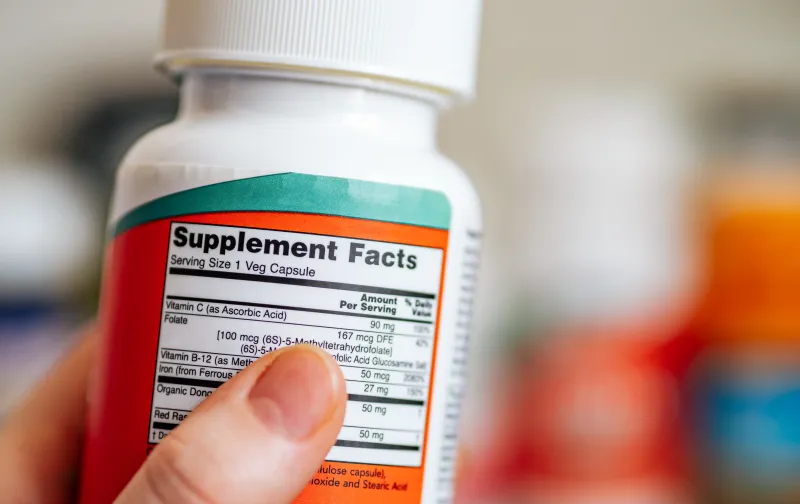
Photo: person reading supplement facts label closely on supplement bottle in store, via nyumi.com
We review a lot of supplements at DBalMax Reviews, which means we read a lot of labels. Like, an unhealthy number of labels.
And after a few years of this, patterns emerge. The same tricks show up again and again, repackaged with new fonts and new influencer campaigns. Most shoppers never catch them because the tricks are designed to survive exactly the amount of attention a typical buyer gives a bottle: about eight seconds in a store aisle, or zero seconds on Amazon.
Here are the seven we see most often, with real examples and a fast way to spot each one.
1. The Fairy Dust Dose
The trick: A proven ingredient appears on the label — great! — at a dose so small it couldn't do anything if it tried.
Real example: We reviewed a 'pump' product listing citrulline at 500mg per serving. The research on citrulline malate for performance uses 6,000–8,000mg. That's a 12–16x gap. The ingredient is there to be read, not to work.
The 30-second test: Google '[ingredient] effective dose' before you buy. If the label dose is less than a quarter of the studied range, the brand is decorating, not formulating.
2. The Proprietary Blend Black Box
The trick: List ten ingredients under one total weight — say, 'Anabolic Matrix 1,200mg' — without disclosing individual amounts. Now every ingredient can appear at any dose, including trace amounts, and the label still looks loaded.
Real example: One 'testosterone complex' we tore down listed 11 ingredients in a 900mg blend. Even if the blend were 100% of the first ingredient, it would be underdosed. In reality? Probably a little of everything, effective amounts of nothing.
The 30-second test: Any blend without per-ingredient breakdowns is an automatic pass. Legit formulators have nothing to hide.
3. The Borrowed Clinical Study
The trick: 'Clinically proven!' — but the study cited tested a different ingredient, a different dose, or a different population entirely. Sometimes it tested the branded version of a compound while the bottle contains a cheap generic lookalike.
Real example: A fat burner's website cited a study on a branded green tea extract standardized to 50% EGCG. The product itself contained generic green tea with no stated standardization. Technically, the ingredient family was studied. Practically, the claim doesn't transfer.
The 30-second test: If the label or site cites a study, check whether it names the exact ingredient form and dose in the bottle. If it doesn't, the citation is a costume.
4. The Stock-Photo Transformation
The trick: Before/after photos that don't involve the product — or the person, or the timeline claimed. Reverse-image search has caught multiple 'customer transformations' on supplement sites that trace back to stock photography libraries.
Real example: We found the same 'after' photo — a very shredded man in a gym — used by two different supplement brands, each claiming him as their customer. He cannot be both. He may be neither.
The 30-second test: Right-click and reverse-image search any transformation photo that's driving a purchase decision. It takes ten seconds and has saved us from more bad products than any lab test.
5. The Flashy Ingredient Front-Load
The trick: Put one trendy, expensive-sounding ingredient on the front label in huge type, then bury the fact that it's dosed at a token amount while the bulk of the formula is cheap fillers and caffeine.
Real example: 'Now with 100mg Ashwagandha!' on a pre-workout where the actual formula is 300mg of caffeine plus food coloring. The headline ingredient is a press release, not a dose.
The 30-second test: Find the hero ingredient's position in the panel. Supplement facts panels list ingredients roughly by weight. If your hero is near the bottom of a short list, it's a cameo, not a star.
6. The Fake Authority Badge
The trick: Seals and phrases that sound like regulation — 'Lab Certified,' 'Pharmaceutical Grade,' 'Doctor Recommended' — that correspond to no independent verification whatsoever.
Real example: 'Pharmaceutical grade' appeared on a product we tested that, when sent to a third-party lab, came back with underdosed actives and no issues worth the phrase. There is no legal definition of 'pharmaceutical grade' for dietary supplements in the US. It means whatever the marketing team wants it to mean.
The 30-second test: Look for verifiable third-party certifications — NSF Certified for Sport, Informed Sport, USP. Those involve actual audits. Everything else is a sticker the brand printed.
7. The Free-Trial Subscription Trap
The trick: Not a label trick, strictly, but it shows up on the same product pages: 'free trial, just pay shipping' that converts into a $79 monthly auto-charge buried in the terms. The FTC has gone after multiple supplement brands for exactly this pattern.
Real example: We counted four separate complaint threads on consumer forums for one 'free bottle' muscle builder, with users reporting charges that continued after cancellation. The product was mediocre. The billing was the actual business model.
The 30-second test: Before entering a card number, search '[brand name] + subscription charge' or check the BBB complaints page. If a brand's most-reviewed feature is its billing department, you know everything you need to know.
The Bigger Picture
None of these tricks are illegal in every case — that's the frustrating part. The US supplement market operates under rules that let marketing run far ahead of evidence. Which means the burden of scrutiny falls on you, the buyer.
The good news: it doesn't require a chemistry degree. It requires thirty seconds, a healthy suspicion of anything that sounds too good, and the willingness to flip the bottle around.
The front of the label is written to sell to you. The back is written to inform you — if the brand has nothing to hide. Start there, and most of this industry's tricks fall apart on contact.