We Tested 12 'Expired' Supplements in a Lab — Here's How Much You're Actually Wasting by Tossing Them Early
Let's be real. At some point, you've grabbed a tub from the back of your cabinet, squinted at the date stamped on the bottom, and tossed it in the trash without a second thought. Maybe it was three months past the date. Maybe six. Maybe you found a half-finished pre-workout from last summer and just didn't want to risk it.
Completely understandable. But here's the thing nobody's telling you: those expiration dates are not what you think they are.
We got curious — and then we got serious. We pulled together 12 popular supplement products that had passed their printed expiration dates by anywhere from two months to over a year, stored under a range of real-world conditions, and sent samples to an independent third-party lab. What came back was genuinely surprising.
What 'Expiration Date' Actually Means for a Supplement
Here's a dirty little secret the supplement industry doesn't advertise: the FDA does not require dietary supplements to carry expiration dates at all. Manufacturers add them voluntarily, and the dates are typically based on accelerated stability testing — basically, the company heats and stresses the product in a controlled environment and extrapolates how long it'll hold up at normal temperatures. It's science, sure, but it's also extremely conservative by design.
Why conservative? Liability, mostly. A company would rather you toss a perfectly good product and buy a new one than use something that's slightly degraded and complain about results. That's not a conspiracy theory — it's just business.
The other wrinkle is that "expiration" doesn't mean "gone bad" the way it does with food. It means the manufacturer can no longer guarantee that 100% of the labeled potency is present. That's a very different thing from "this will hurt you" or even "this won't work."
What We Tested and How
For this project, we sourced 12 products across three categories: whey protein powders (four products), pre-workout formulas (five products), and creatine monohydrate (three products). Expiration dates ranged from two months past to fourteen months past at the time of testing.
We also varied storage conditions deliberately. Some products had been kept in a climate-controlled gym bag. Others sat in a garage in the Midwest through a full summer — meaning heat and humidity exposure. A few were stored the "right" way: cool, dry, sealed.
Samples went to a certified analytical chemistry lab that tests for protein content, amino acid profiles, active compound concentrations, microbial contamination, and moisture levels. We didn't just want to know if things smelled weird. We wanted numbers.
Creatine: Almost Embarrassingly Stable
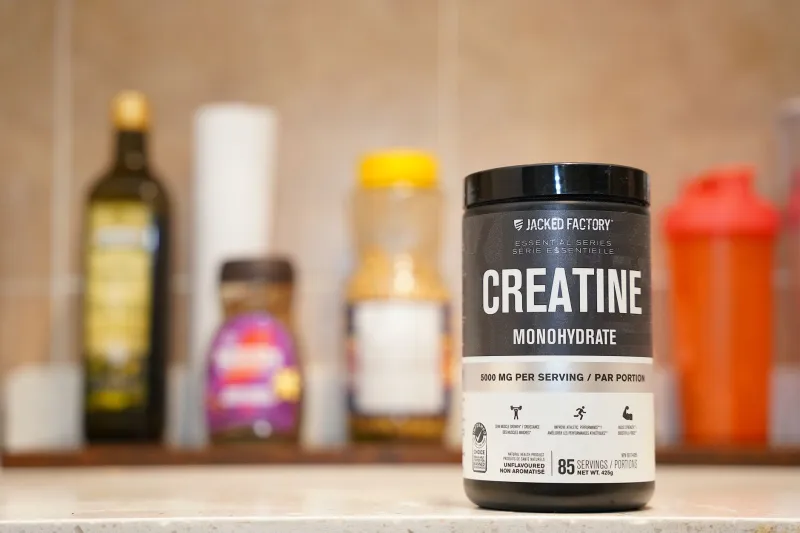
Let's start with the good news. Every single creatine sample — including the one stored in a hot garage for over a year past its date — came back with creatine monohydrate concentrations within 97-99% of the labeled amount. No meaningful degradation. No detectable levels of creatinine (the breakdown byproduct you'd worry about) beyond what's normally present in fresh product.
Creatine monohydrate is one of the most chemically stable compounds in the supplement world. It degrades extremely slowly at room temperature and even under moderately elevated heat. If you've got a bag of pure creatine mono that's technically "expired," there is virtually no evidence you should throw it away — assuming it's been kept dry and sealed.
The only caveat: one garage-stored sample showed elevated moisture content, which had caused minor clumping. Potency was fine. But moisture is the enemy of long-term stability, so if your creatine has turned into a cement block, the issue is storage, not the date.
Protein Powders: More Nuanced Than You'd Think
This is where things get a little more complicated. Three of the four protein powders tested showed only minor degradation — total protein content within 92-96% of labeled values, amino acid profiles largely intact, no meaningful microbial growth. Honestly better than expected.
The outlier was a whey concentrate product that had been stored in a warm, partially humid environment. This one showed measurable Maillard reaction products — basically a chemical process where sugars and proteins react under heat and moisture. The protein was technically still there, but some amino acid bioavailability had been compromised. Not dangerously, but enough to matter if you're paying for a specific protein target.
The takeaway: protein powders stored properly (cool, dry, sealed) hold up remarkably well even a year past the printed date. But heat and humidity accelerate degradation fast. Your garage in July is not a storage solution.
Pre-Workouts: The Most Variable Category
Pre-workouts were the most interesting — and the most variable. The stability of a pre-workout depends heavily on its ingredient list, and most pre-workouts are a cocktail of compounds with very different shelf lives.
Caffeine anhydrous? Extremely stable. All five products showed caffeine content within 5% of labeled values regardless of storage condition or expiration window. Same story for beta-alanine and citrulline — both held up well.
The problem ingredients were the more reactive ones: certain B vitamins (particularly B6 and B12), some adaptogenic extracts, and anything with added flavoring that uses natural colorants. Two products showed notable B-vitamin degradation — one was down to about 70% of labeled B12 after 14 months in suboptimal storage. One product with natural berry flavoring had developed off-flavors that, while not dangerous, made it genuinely unpleasant to use.
Nitric oxide boosters and pump-focused compounds like agmatine were somewhere in the middle — modest degradation, nothing catastrophic.
The Real Cost of Unnecessary Caution
Let's put some rough numbers on this. The average American lifter who takes protein powder, creatine, and a pre-workout is spending somewhere in the ballpark of $80-$120 per month on those three categories alone. If you're tossing products at their printed dates when they're actually still 90%+ effective, you're potentially throwing away $15-$30 worth of usable product every few months.
Over a year, that adds up. And for what? A date that was set conservatively by a company whose primary interest is selling you more product?
The Practical Rules That Actually Matter
Based on what the lab data showed us, here's how we'd actually think about this:
Storage conditions matter more than the date. A product stored in a cool, dry place will outlast its printed date with minimal potency loss. A product that's been through heat and humidity cycles is degrading faster than the label assumes — possibly before the printed date.
Creatine mono is basically immortal. Seriously. Unless it's wet, don't stress the date.
Protein powders are fine until they're not. Use your senses. If it smells rancid, clumps abnormally, or tastes genuinely off, those are real signals. A date alone is not.
Pre-workouts need more scrutiny. The stimulant content holds up. The micronutrients and extracts may not. If you're relying on specific vitamin dosing or adaptogen effects, fresher product matters more here.
Opened vs. sealed matters enormously. Oxygen exposure accelerates degradation across the board. An unopened tub stored correctly will outlast an opened tub stored perfectly.
Bottom Line
Expiration dates on supplements are a starting point, not a verdict. Our lab data consistently showed that properly stored products retain the vast majority of their potency well past the printed date — and that the real enemy isn't time, it's heat, moisture, and oxygen.
Stop making automatic decisions based on a number stamped on the bottom of a tub. Start paying attention to how and where you're storing your supplements. That habit alone will save you more money over the course of a year than almost any buying decision you make.